- English
- French
- German
- Portuguese
- Spanish
- Russian
- Japanese
- Korean
- Arabic
- Greek
- German
- Turkish
- Italian
- Danish
- Romanian
- Indonesian
- Czech
- Afrikaans
- Swedish
- Polish
- Basque
- Catalan
- Esperanto
- Hindi
- Lao
- Albanian
- Amharic
- Armenian
- Azerbaijani
- Belarusian
- Bengali
- Bosnian
- Bulgarian
- Cebuano
- Chichewa
- Corsican
- Croatian
- Dutch
- Estonian
- Filipino
- Finnish
- Frisian
- Galician
- Georgian
- Gujarati
- Haitian
- Hausa
- Hawaiian
- Hebrew
- Hmong
- Hungarian
- Icelandic
- Igbo
- Javanese
- Kannada
- Kazakh
- Khmer
- Kurdish
- Kyrgyz
- Latin
- Latvian
- Lithuanian
- Luxembou..
- Macedonian
- Malagasy
- Malay
- Malayalam
- Maltese
- Maori
- Marathi
- Mongolian
- Burmese
- Nepali
- Norwegian
- Pashto
- Persian
- Punjabi
- Serbian
- Sesotho
- Sinhala
- Slovak
- Slovenian
- Somali
- Samoan
- Scots Gaelic
- Shona
- Sindhi
- Sundanese
- Swahili
- Tajik
- Tamil
- Telugu
- Thai
- Ukrainian
- Urdu
- Uzbek
- Vietnamese
- Welsh
- Xhosa
- Yiddish
- Yoruba
- Zulu
What are the Different Types of Ball Bearings?
By using spherical rolling elements between the inner and outer rings, ball bearings are basic mechanical parts that make it possible for many industrial applications to rotate smoothly. These carefully designed parts come in a number of different layouts that are made to work with different types of loads, speeds, and environmental conditions. Knowing about the different kinds of ball bearing helps engineers and purchasing agents choose the best ones for use in wind turbines, heavy machinery, mining equipment, and spacecraft.
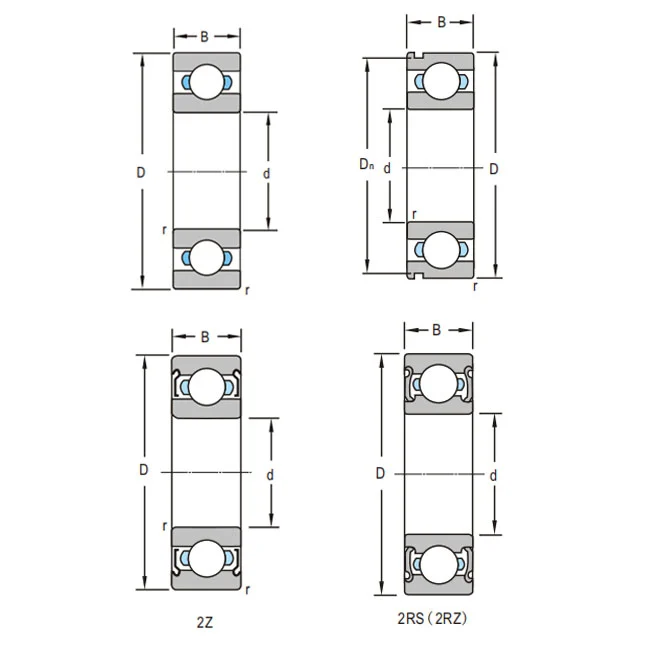
Overview of Ball Bearings and Their Core Functions
Ball bearings are key parts of industrial machinery that are made to reduce friction and support both radial and axial loads while the machine is rotating. The basic idea behind how it works is that spherical balls roll between carefully machined inner and outer rings. This makes very few points of contact, which means a lot less energy loss than with sliding friction.
Essential Components and Materials
The four main parts that make up the core architecture are the inner ring, the outer ring, the rolling balls, and the cage assembly. Each part is very important to the overall performance of the bearing. The rings give the balls a way to move, and the cage keeps the balls at the right distance apart and stops them from hitting each other while the machine is running.
The choice of material has a big effect on how well a bearing works. For everyday use, high-carbon chromium steel (GCr15) is very hard and doesn't wear down easily. Ceramic balls are great for high-speed applications because they can handle high temperatures and keep electricity from flowing through them. When steel rings and ceramic balls are combined in hybrid designs, they work better in tough environments.
Load Distribution Mechanisms
Knowing how loads are distributed helps procurement managers understand how the choice of bearings affects the efficiency and longevity of a machine. Radial loads are applied perpendicular to the shaft axis, and axial loads are applied perpendicular to the rotation axis. The contact angle between the balls and the raceways determines how much weight they can hold and how they work.
This basic information helps OEMs and industrial buyers around the world make smart choices about how to best optimize maintenance schedules and buying strategies. Choosing the right bearings has a direct effect on how reliable equipment is, how much it costs to run, and how efficiently it produces goods in many different industries.
Comprehensive Guide to Different Types of Ball Bearings
There are different types of ball bearing on the market, and each one is designed to meet specific operational needs. Knowing about these differences helps business-to-business clients choose bearings that are right for their specific industrial uses and performance needs.
Deep Groove Ball Bearings
In industrial settings, Deep groove ball bearings are the most useful and flexible type of bearing. Deep raceway grooves in these bearings allow them to handle both radial and moderate axial loads at the same time. The design allows for high rotational speeds while still distributing the load very well.
It can be used for everything from electric motors and pumps to auto parts and general machinery. This group is shown by the 6308 series, which has a 40mm bore diameter, a 90mm outer diameter, and a 23mm width. These measurements give strong performance in medium-duty uses where dependability and low cost are most important.
Angular Contact Ball Bearings
When precise positioning is needed under combined load conditions, angular contact bearings are the best choice. The contact angle, which is usually 15°, 25°, or 40°, determines how much weight the bearing can hold and how it works. Single-row versions handle axial loads that only go in one direction, while double-row versions handle forces that go in both directions.
When compared to single-row options, double-row angular contact bearings are more rigid. The two-row design spreads stress over many contact points, which lowers the load on each ball and increases its useful life. This arrangement is very important for machine tool spindles, car wheel hubs, and other precise machinery that needs to bend very little when it's loaded.
Self-Aligning Ball Bearings
Self-aligning bearings can handle misaligned shafts and housing deflection because the outer ring raceway is shaped like a sphere. Because of this, they are very useful in situations where maintaining perfect shaft alignment during operation is hard or impossible.
The internal geometry lets the angles be off by up to two to three degrees without affecting the performance. Agricultural machinery, conveyor systems, and mining equipment can use this tolerance feature because the shafts in these areas often deflect due to operational stresses or differences in mounting.
Thrust Ball Bearings
Thrust ball bearings are only good at handling heavy axial loads while still letting the shaft turn at moderate speeds. The 90-degree contact angle makes them perfect for supporting loads vertically, which is why they are needed for vertical pumps, marine propulsion systems, and heavy machinery that needs to be positioned axially.
There are three separate parts to these bearings: the shaft washer, the housing washer, and the ball-and-cage assembly. The design keeps things from going horribly wrong when radial bearings are put under only axial stress. Single-direction Thrust bearings, on the other hand, can't handle radial loads and need a minimum amount of axial preload to keep the ball from sliding.
Comparing Ball Bearings with Other Bearing Types
Procurement professionals have to look at more than one type of bearing technology when choosing the best Solutions for different situations. This comparison shows buyers when ball bearing technology is better than other options like needle, roller, or sleeve bearings.
Load Capacity and Speed Characteristics
Because they have point contact and less internal friction, ball bearings work great in high-speed situations. When compared to sliding contact bearings, rolling element contact generates less heat, which allows for long-term high-speed operation. However, roller bearings can hold more weight because of the way their line contact geometry is designed.
The choice of bearing is based on the trade-off between speed and load capacity. Ball bearings can usually handle speeds that are 1.5 to 2 times faster than similar roller bearings while still making enough noise and needing to be oiled.
Maintenance and Reliability Factors
Due to their strong design and sealed construction, ball bearings usually need less maintenance than other types of bearings. Sealed ball bearings keep out dirt and keep the lubrication in, which greatly increases the time between service intervals. Open bearings are easier to re-grease, but they need to be serviced more often.
Needle bearings are small, but they can't hold much weight and need very accurate housing tolerances. Sleeve bearings work quietly and absorb shock, but they need to be oiled all the time and have higher friction losses. These factors affect how manufacturers of industrial equipment figure out the total cost of ownership.
Selecting the Right Ball Bearing for Your Industrial Needs
In order to choose the right bearings, you need to carefully consider things like the load size, the speed of rotation, the environment, and the level of accuracy needed. This criteria-based approach makes sure that performance is at its best while costs are kept to a minimum.
Load Analysis and Speed Requirements
The first step in load analysis for ball bearing is to find the maximum radial and axial forces that will be present during operation. Dynamic load ratings show how much weight something can hold when it is rotating, while static ratings show how much weight something can hold when it is still or moving slowly. Depending on how important the application is and how the load changes, safety factors are usually between 1.5 and 3.0.
Limits on speed depend on the size of the bearings, how they are oiled, and the temperature at which they are used. The DN value, which is the bearing bore diameter times the speed, gives you a starting point, but thermal concerns usually put limits on the speed that can be used. At high speeds, choosing the right lubricant is very important to keep things from overheating and breaking down too soon.
Material Selection and Environmental Considerations
Choices of materials have a big effect on how well bearings work in tough conditions. Standard bearing steel is very durable and works well in most situations. Stainless steel, on the other hand, doesn't rust and is good for marine or chemical processing environments. Ceramic balls make things less conductive with electricity and last longer in high-temperature settings.
Extreme temperatures, exposure to contamination, and chemical compatibility are all environmental factors. For use at temperatures above 150°C, you might need special grades of steel or ceramics. In dirty places, sealed bearings with the right seal designs are helpful. When materials are exposed to chemicals, they need to be carefully chosen to keep them from corroding or breaking down.
Precision Classes and Tolerance Requirements
The dimensional and geometric tolerances that affect rotational accuracy and noise levels are set by precision classes (ABEC ratings). Standard precision (ABEC 1) is good for most industrial uses, while higher precision classes (ABEC 5–9) are better for machine tools and aerospace uses that need very little runout.
The choice of tolerance has an effect on both performance and cost. Although they cost a lot more, higher precision bearings work better and last longer. Upgrades to precision should be based on the needs of the application, since too much precision can waste resources without providing any operational benefits.
Procurement Insights and Maintenance Tips for Ball Bearings
Evaluation of suppliers, management of inventory, and planning for maintenance are all important parts of good procurement strategies that make sure there is a steady supply of ball bearing while keeping total ownership costs as low as possible. These insights help global B2B clients build strong supply chains that keep operations going all the time.
Supplier Selection and Quality Assurance
Certifications, testing capabilities, and on-time delivery are all ways that trusted suppliers show that their quality is consistent. ISO 9001 certification means that quality management is done in a planned way, while ISO/TS 16949 certification is specific to the needs of the automotive industry. Supplier audits check that the company can make things and that quality control procedures are followed.
Material Certificates, dimensional inspection reports, and performance testing data should all be part of quality documentation. Traceability standards are different for each industry. For example, aerospace and nuclear applications need full documentation of all materials and processes. Setting clear quality standards stops disagreements and makes sure that all products meet the same standards.
Inventory Management and Bulk Purchasing
Carrying costs and stock-out risks are balanced in strategic inventory management. To keep production from stopping, critical applications need safety stock, and just-in-time delivery can be set up when consumption patterns are known ahead of time. Buying in bulk lowers unit costs, but it also requires more storage space and inventory.
Orders for custom bearings take longer to process, but they work better in certain situations. Deliveries of standard bearings are faster and cheaper because of economies of scale. The choice is based on how important the application is, how much it needs to be used, and how well it needs to work.
Maintenance Best Practices
With regular maintenance, bearings last longer and don't break down when they're least expected. When to lubricate depends on how the machine is used, the type of bearing, and the lubricant used. Too much lubrication can make things too hot, and not enough lubrication can cause things to wear out and break down too soon.
Techniques for condition monitoring include analyzing vibrations, keeping an eye on temperatures, and analyzing lubricants. These methods find early warning signs before a failure of this magnitude happens. Predictive maintenance programs cut down on unplanned downtime and make the best use of data to lower maintenance costs.
Conclusion
Knowing about the different kinds of ball bearing lets you make smart purchases that improve the performance of your equipment while keeping costs low. Deep groove bearings are flexible and can be used in a wide range of situations. Angular contact bearings are best for precise tasks, self-aligning bearings can handle being out of alignment, and thrust bearings can handle only axial loads. To make the right choice, you need to compare the available bearing technologies to your load requirements, speed capabilities, environmental conditions, and precision needs. Effective procurement includes evaluating suppliers, making sure products are of good quality, and planning for maintenance to make sure there is a steady supply of bearings for industrial operations.
FAQ
What factors determine ball bearing lifespan in industrial applications?
Bearing life depends on how much weight is on it, how well it is oiled, how hot it is working, and how much dirt it is exposed to. Service life is greatly increased by proper installation, proper lubrication, and regular maintenance. Working within the design load limits and keeping the work area clean will keep it from breaking down too soon.
How do I measure bearings accurately for replacement purposes?
Use precision calipers or micrometers to measure the bore diameter, the outer diameter, and the width. Write down the measurements in millimeters and check them against standard bearing tables. Most of the time, bearing numbers show sizes. For most standard series, the last two digits show the bore diameter in millimeters.
What are early warning signs of bearing failure?
Increasing vibration, strange noises, high temperatures, and contaminated lubricant are all common signs of failure. These signs can be found before a catastrophic failure happens with regular condition monitoring. Taking care of early warning signs through proper maintenance keeps equipment from breaking down and causing production to stop.
Partner with INNO Bearing for Your Ball Bearing Solutions
Precision-engineered bearing solutions from INNO Bearing are backed by nearly 30 years of manufacturing experience and leadership in the industry. Our wide range of products includes both standard and custom ball bearing configurations with a diameter of up to φ5000mm. These can be used in a wide range of industries, from wind energy to aerospace systems. As a reliable ball bearing manufacturer, we offer fast shipping, strict quality control, and full technical support to make sure your important applications run at their best. Email our engineering team at sales@inno-bearing.com to talk about your specific needs and find out how our advanced bearing technology can help your business run more smoothly and reliably.
References
Harris, T.A. & Kotzalas, M.N. "Advanced Concepts of Bearing Technology: Rolling Bearing Analysis." CRC Press, 2019.
Eschmann, P., Hasbargen, L. & Weigand, K. "Ball and Roller Bearings: Theory, Design and Application." John Wiley & Sons, 2018.
Jones, A.B. The 2020 Journal of Basic Engineering article is called "A General Theory for Elastically Constrained Ball and Radial Roller Bearings Under Arbitrary Load and Speed Conditions."
The Hamrock, B.J. and Dowson, D. Industrial Lubrication and Tribology, 2021. "Ball Bearing Lubrication: The Elastohydrodynamics of Elliptical Contacts." IJT.
ISO 281:2019. "Dynamic Load Ratings and Rating Life of Rolling Bearings." 2019 International Organization for Standardization.
Standard 9 from ANSI/ABMA. "Load Ratings and Fatigue Life for Ball Bearings." American Bearing Manufacturers Association, 2020.

Learn about our latest products and discounts through SMS or email